Caring for you as we would for ourselves

A Comprehensive Guide to Birth Control: Methods, Pros, and Cons

Contraception is an essential part of reproductive health, allowing people to plan their families and prevent unwanted pregnancies. There are a wide variety of contraceptive methods, each with its own advantages, disadvantages, and levels of effectiveness. Choosing a method of contraception is a deeply personal decision and should be tailored to your lifestyle, age, and specific health needs. Whether you’re looking for a temporary, permanent, hormonal, or non-hormonal method, this guide will help you navigate the available options to find the one that’s right for you.
Hormonal Methods
  • those that combine estrogen and progestin and come in the form of a pill, patch, or vaginal ring. The main effect of estrogen-progestin contraceptives is to block ovulation. They also thicken the cervical mucus, making it impermeable to sperm, and thin the lining of the uterus, making it unsuitable for the implantation of a fertilized egg
  • those that consist solely of progestins. They come in the form of a pill, implant, IUD, or injection. They work primarily by thickening the cervical mucus. They also partially block ovulation and thin the uterine lining, thereby reducing the likelihood that a fertilized egg will implant and develop there.


Some women are hesitant to take synthetic hormones because of side effects reported by a small number of women, such as breast tenderness, mood swings, decreased libido, and fear of weight gain. It is important to note that hormones can help alleviate certain menstrual-related disorders, particularly in cases of polycystic ovary syndrome (PCOS) and endometriosis, and can reduce acne. Furthermore, there is a lower incidence of endometrial, ovarian, and colon cancers among users of estrogen-progestin hormones.

Every woman is different, and it is important to discuss your options with a gynecologist before making a decision.

Estrogen-progestin combinations

Combined oral contraceptive (COC)

The combined oral contraceptive contains both estrogen and progestin.

Advantage: Easy to take daily

Disadvantages:

  • May be missed
  • Reduced effectiveness in case of vomiting or diarrhea
  • Irregular bleeding
  • Does not protect against sexually transmitted infections (STIs)

Vaginal ring

A soft plastic ring containing estrogen and a progestin, which is inserted into the vagina for 3 weeks, followed by a one-week break during which the woman has her period.

Disadvantages:

  • Must remember to change it once a month
  • Not always easy to use
  • Does not protect against STIs

Patch

The patch looks like a small, thin bandage that continuously releases estrogen and a progestin, which are absorbed through the skin and enter the bloodstream. The patch is applied to the skin—never on the breasts—and is changed once a week for 3 weeks, followed by a one-week break.

Advantages: Easy to use and less likely to be missed than oral contraceptives

Disadvantages:

  • You have to remember to change it every week
  • Irregular bleeding
  • Less effective in women weighing more than 90 kg
  • Does not protect against STIs
Progestins

Mini-pill or POP (progesterone-only pill)

The mini-pill contains only progesterone. It is taken every day at the same time, without a break.

Advantages: It is recommended for women who are breastfeeding or for those with contraindications to estrogen

Disadvantages:

  • May be missed
  • Must be taken at a regular time
  • Reduced effectiveness in case of vomiting or diarrhea
  • Does not protect against STIs


Hormonal IUD

A device containing progesterone that is inserted into the uterus.

Advantages: Lasts 5–8 years and eliminates the risk of missing a dose.

Disadvantages:

  • Insertion may be painful
  • STI screening is required before insertion
  • The IUD may shift or be expelled (1 in 20)
  • Does not protect against STIs

Implant

Under local anesthesia, a progesterone-containing rod is inserted under the skin of the arm and remains there for 3 years.

Advantages: Long-lasting and eliminates the risk of missed doses

Disadvantages:

  • The rod may be visible and cause discomfort
  • Does not protect against STIs.
  •  


Injection

A progesterone injection is administered every 3 months.

Advantages:

Stops menstruation in most women and lasts 3 months

Disadvantages:

  • Possible weight gain; increased risk for people under 18 or with a BMI over 30
  • Must be scheduled every 3 months
  • May temporarily reduce bone density while in use
  • Fertility does not return immediately
  • Does not protect against STIs
Non-hormonal methods

Non-hormonal methods of contraception offer an alternative for people who wish to avoid using hormones for health reasons or personal preference. These methods rely on physical or natural mechanisms to prevent pregnancy, such as intrauterine devices, mechanical barriers, or cycle tracking techniques. They may be suitable for those who prefer a more natural approach or who have contraindications to hormonal methods. Although effective, these options sometimes require more discipline and careful monitoring to ensure their effectiveness.


Copper IUD

A copper-containing device is inserted into the uterus. It has a lifespan of 5 years. The copper IUD can be used as emergency contraception.

Mechanism of action: Copper has a spermicidal effect and renders sperm inactive.

Advantages: Lasts an average of 5 years.

Disadvantages:

  • May cause heavier and more painful periods
  • Insertion may be painful
  • STI screening is required before insertion
  • The IUD may shift out of place (1 in 20 risk)
  • Does not protect against STIs


Diaphragm or cervical cap

Diaphragms and cervical caps are silicone cups placed at the back of the vagina to cover the cervix. By covering the cervix, they create a barrier for sperm, which are less likely to come into contact with the egg.

Advantage: offers some degree of protection against STIs

Disadvantages: less effective than other methods and complicated to use


Male and female condoms

Condoms are generally made of very thin latex. Other materials are available for people with latex allergies. The male condom covers the penis; the female condom is inserted into the vagina. Condoms prevent sperm from entering the vagina.

Advantages: protection against STIs, though to a lesser extent for the female condom

Disadvantages:

  • Some experience is required
  • Some people report reduced sexual pleasure


The Lactational Amenorrhea Method (MAMA)

The high levels of prolactin produced during breastfeeding inhibit the secretion of the cascade of hormones necessary for ovulation. Without ovulation, fertilization cannot occur.

Requirements: Three conditions are essential for the success of this method:

  • Being within 6 months postpartum
  • Amenorrhea (absence of menstruation)
  • Exclusive breastfeeding, with no more than 4 to 6 hours between feedings, including at night

Advantages: Free and acceptable in most religions and cultures

Disadvantage: Very restrictive

Natural Methods Based on the Fertile Window

There are fertility charts and mobile apps that can help track changes and predict fertile days. This method of contraception can be reliable if used consistently and correctly.
General description: Abstaining from penetrative sex for the 5 days before ovulation and up to one day afterward.
Mechanism of action: A woman is fertile only during a specific period of her cycle, namely around ovulation, which generally occurs two weeks before the start of her next period. Several methods can be used to determine fertile periods.
The Billings Method involves abstaining from sex from the onset of clear cervical mucus until 4 days after the last occurrence of such mucus.
The basal body temperature method involves taking your temperature every day upon waking after at least 6 hours of sleep. A woman is considered fertile for the 3 days following a rise in temperature of at least 0.5° during the ovulatory peak.
The symptothermal method combines these two methods: cervical mucus indicates the first day of fertility, and the rise in temperature indicates the last day.
The calendar method (Ogino-Knaus) involves tracking and recording cycles over several months to establish an average “at-risk” period. This method is only suitable for women with regular cycles.
Finally, ovulation tests can be used either to prevent or to promote pregnancy.


Advantages:

Free

Helps you learn about how your body works

Acceptable in most religions and cultures

Disadvantages:

  • Very restrictive
  • Requires a learning period to track cycles
  • Requires a very regular cycle
  • Less reliable in cases of illness, stress, or travel
  • Abstinence during the most fertile days


Withdrawal

This method is not recommended. It involves removing the penis from the vagina before ejaculation. Sperm do not come into contact with the egg, and fertilization cannot occur.

Advantages: Acceptable in most religions and cultures

Disadvantages:

  • Requires a great deal of self-control on the part of the partner
  • Semen may leak into the vagina before ejaculation, making this an unreliable method for preventing pregnancy
  • Does not protect against STIs
Quasi-definitive methods

Semi-permanent methods of contraception, such as vasectomy for men and tubal ligation for women, offer a permanent solution for those who no longer wish to have children. These surgical procedures are highly effective, providing nearly complete protection against pregnancy, but should be considered irreversible; although reversal procedures exist, they do not guarantee success. It should also be noted that they do not offer protection against sexually transmitted infections (STIs).


Vasectomy

A vasectomy is a surgical procedure for male sterilization. Under local anesthesia, the vas deferens on both sides are cut and sealed, thereby preventing sperm from entering the seminal fluid. A vasectomy should be considered an irreversible procedure, because while it is theoretically reversible, the chances of success are only about 50%.
While this method is nearly 100% reliable, it is not effective immediately. After about 30 ejaculations or approximately 4 months, the semen is analyzed, and only after confirmation that it is free of sperm is it possible to discontinue other forms of contraception.
Advantages:
Suitable for men who no longer wish to have children
Quick outpatient procedure
Disadvantages:
Minor surgical procedure with the usual inherent risks (infection, bleeding), though these are rare
No protection against STIs

Tubal Sterilization

Tubal ligation is a surgical procedure for female sterilization. Under general anesthesia, the fallopian tubes are cut and then sealed using sutures or a clip, either via laparoscopy or by laparotomy (an incision in the abdomen) during a cesarean section or another abdominal procedure.
Female sterilization is very difficult to reverse and should be considered permanent.
Advantages: Suitable for people who no longer wish to have children
Disadvantages:

  • Surgical procedure with the usual risks inherent in any surgery (infection, bleeding)
  • Does not protect against STIs
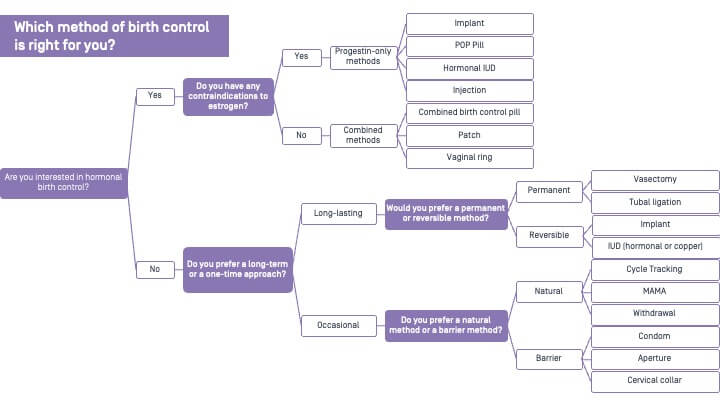
Which method of birth control is right for you?

contraception methods

FAQ on Contraception

Can a woman who has never had children get an IUD inserted?

Unless there are specific contraindications, yes, you do not need to have had a child before to have an IUD inserted.

Which method is the most reliable?

Aside from sterilization—a more or less permanent and radical solution—hormonal implants and hormonal IUDs are the most reliable methods of contraception.

Can hormonal birth control reduce my menstrual bleeding and cramps?

Yes, menstrual cramps (dysmenorrhea) and heavy periods (menorrhagia) can be relieved with hormonal birth control.

What is the most appropriate form of birth control for breastfeeding women?

In general, the method best suited for breastfeeding women is the progestin-only pill.

Is it dangerous to take the pill continuously and not have a period?

There is no risk associated with skipping your period when taking several packs of birth control pills in a row without a break. There is no risk of blood buildup because the lining of the uterus remains thin. This is beneficial for people who are iron-deficient.

Does the birth control pill cause weight gain?

The birth control pill sometimes increases appetite in some women. Studies have shown, however, that most women’s weight remains stable.

Smoking is a contraindication for estrogen-progestin therapy—what about e-cigarettes?

Since there is currently insufficient scientific data to determine the impact of the combination of estrogen-progestin birth control and e-cigarettes, it is best to apply the precautionary principle and opt for progestin-only birth control.

Am I at a higher risk of cancer if I take hormones?

Studies have shown a very slight increase in the risk of breast cancer and cervical cancer among people who use hormonal birth control compared to those who do not. However, it reduces the risk of ovarian and endometrial cancer. While taking hormones may be contraindicated for some people, it’s important to note that there are factors that have a much greater impact on cancer risk than hormone use.

Specialties involved