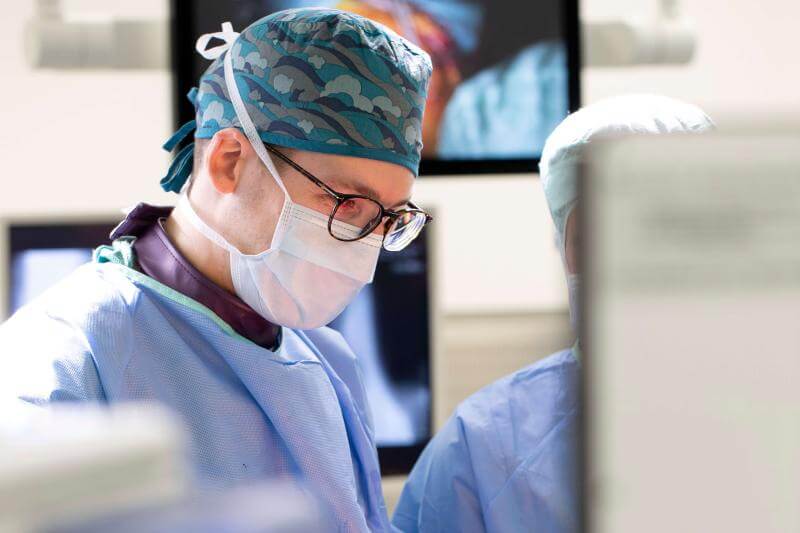
Dr. Billières, can you describe this patient’s case and what led to the surgery?
This is a 25-year-old patient who suffered two severe sprains of his left knee, resulting in injuries to the anterior cruciate ligament and the posterior cruciate ligament. These injuries caused severe damage to the lateral meniscus, which could not be repaired during the initial surgery.
One of the menisci’s essential functions is to distribute load within the knee, and the absence of a meniscus in either the lateral or medial compartment can cause short-term pain and long-term osteoarthritis. In this patient’s case, who no longer had a lateral meniscus, the pain was indeed very pronounced. That is why we considered a meniscus transplant, which yields good results in this type of patient—young, active, and without advanced osteoarthritis.
But even though it was indicated in this specific case, is the use of meniscus transplants still limited?
Fortunately, the early use of meniscectomy is becoming less and less common, which helps prevent the need to resort to a transplant. This wasn’t always the case in the past; there has been a shift in surgeons’ approach in this regard. Thirty or forty years ago, it was thought that the technical mistake was not removing enough of the meniscus. In recent years, we’ve come to understand that we should avoid removing parts of the meniscus as much as possible.
In a young patient, even if the tissue isn’t of good quality, we’ll prefer to repair it, even without certainty that it will heal. This is because we know that, in the long term, the prognosis is poor if the meniscus is removed. However, there are times when the patient’s medical history and the occurrence of injuries leave us with no other choice. These are generally complex situations, often following several previous surgeries, where repair has already been attempted once or twice but without success. But it’s true that this is quite rare—fortunately for patients.
Is a meniscus graft always indicated after a meniscectomy?
No, there are many reasons not to do so. In particular, when osteoarthritis is too advanced. Beyond a certain point, it’s too late—the damage is done. In such cases, other types of surgery must be considered. We also avoid performing the procedure past a certain age. The current consensus is around age 50.
It also depends on which meniscus is affected. For the medial meniscus, the injury is often due to wear and tear in patients over 40, and removing the damaged portion of the meniscus is generally better tolerated, with osteoarthritis typically developing twenty or thirty years later. In these cases, the impact is more limited. On the other hand, when the lateral meniscus cannot be saved, the anatomy of that side of the joint means that osteoarthritis develops in 40% of cases within ten years. So for a 20-year-old who loses their lateral meniscus, it is likely that this will be poorly tolerated in the short term and then in the long term, with the onset of osteoarthritis. The goal of a meniscus transplant is therefore to relieve pain and improve knee function, but also to slow the progression of osteoarthritis.
In the case we’re discussing today, how was the decision made?
After reviewing the patient’s history of injuries and surgeries, as well as the symptoms he was experiencing, I ordered several radiological exams that confirmed a significant portion of the lateral meniscus was missing. The pain had persisted for several months and was linked to the fact that he had virtually no lateral meniscus left, so a transplant was indicated. Once the diagnosis was made and the procedure and expected outcomes were explained, he decided to proceed.
Is it difficult to find a donor?
It can take time to find the right meniscus. It comes from a deceased organ donor, and there are specific criteria that must be met. We must ensure it matches the right or left side, whether it’s a lateral or medial meniscus, and finally, the size of the new meniscus must correspond to the patient’s original meniscus.
What are the main challenges of this surgery?
Meniscus transplantation is a procedure that takes about an hour. The graft is received attached to a piece of tibia, which must be prepared by securing it with several sutures. The operation is then performed arthroscopically. First, the remnants of the old meniscus are removed, and then the new one is reinserted. It is reinserted onto the tibia at its anterior and posterior attachments by creating tunnels through the tibia. Along its periphery, the meniscus is sutured in place using suture threads. For the surgeon, this requires mastery of a wide range of suturing techniques within a single procedure. This is one of the most technically demanding procedures for a surgeon specializing in knee conditions.
Care must also be taken with regard to other associated injuries. The knee must be stable for the meniscus to integrate properly. If there is a torn anterior cruciate ligament, it must be repaired at the same time as the meniscus transplant. And if there is an alignment issue—as was the case with this patient, who had bowlegs or knock-knees—it must be corrected in the affected compartment. If the deviation from the normal axis exceeds 5 degrees, correction is performed. Otherwise, the misalignment of the limb places excessive stress on the meniscus.
How does rehabilitation proceed?
The patient stays in the hospital for a few days, with the length of stay depending on the associated procedures. In this specific case, the patient stayed for four days because I had to perform a femoral osteotomy in addition to the meniscal graft, but in simpler cases, two days are sufficient. Then rehabilitation begins, which will be quite lengthy. For six weeks, the patient is not allowed to put weight on the operated side, but can move the knee between 0 and 90 degrees and begins physical therapy right away. A brace is not necessary; crutches are sufficient.
After six weeks, the patient begins to bear weight on the operated knee and starts more intensive physical therapy to rebuild muscle strength and restore full knee mobility. It takes at least six months to regain full function through specialized rehabilitation.
Can we expect a full recovery of knee function? For example, if the patient used to play a contact sport, is that still a possibility?
We’re talking about people who experience pain in their daily lives. It’s important to emphasize that the primary goal in their case isn’t to resume sports, but simply to return to a normal life and go back to work.
Returning to sports is possible, but only by taking care of the knee for the future. Some patients already have cartilage damage, and we must also remember that the grafted meniscus behaves like a normal meniscus. There’s no guarantee that, in the event of another injury, it won’t tear as well, requiring the process to start all over again. Most often, these patients have a fairly long surgical history and have already undergone several operations, so we generally find that they realize on their own that they need to be cautious to avoid further injuries.
Comments by Dr. Julien Billières, interviewed by Yannick Richter, communications officer.