
What are achalasia and gastroparesis?
Achalasia is a motor disorder of the esophagus that affects approximately one in 10,000 people. The muscle located at the junction between the esophagus and the stomach—the lower esophageal sphincter—does not relax properly. Food has difficulty passing through or may even become blocked. The most common symptoms include difficulty swallowing (dysphagia), regurgitation, chest pain, and weight loss, which can become significant in advanced cases.
Gastroparesis, on the other hand, affects gastric emptying: the stomach empties too slowly into the intestine, leading to nausea, bloating, and a debilitating early feeling of fullness. A persistent or excessive spasm of the pyloric sphincter between the stomach and the intestine may be the cause.
These two conditions share a common mechanism: muscle dysfunction that prevents the normal passage of food. It is precisely this mechanism that the POEM procedure targets.
How does the POEM procedure work?
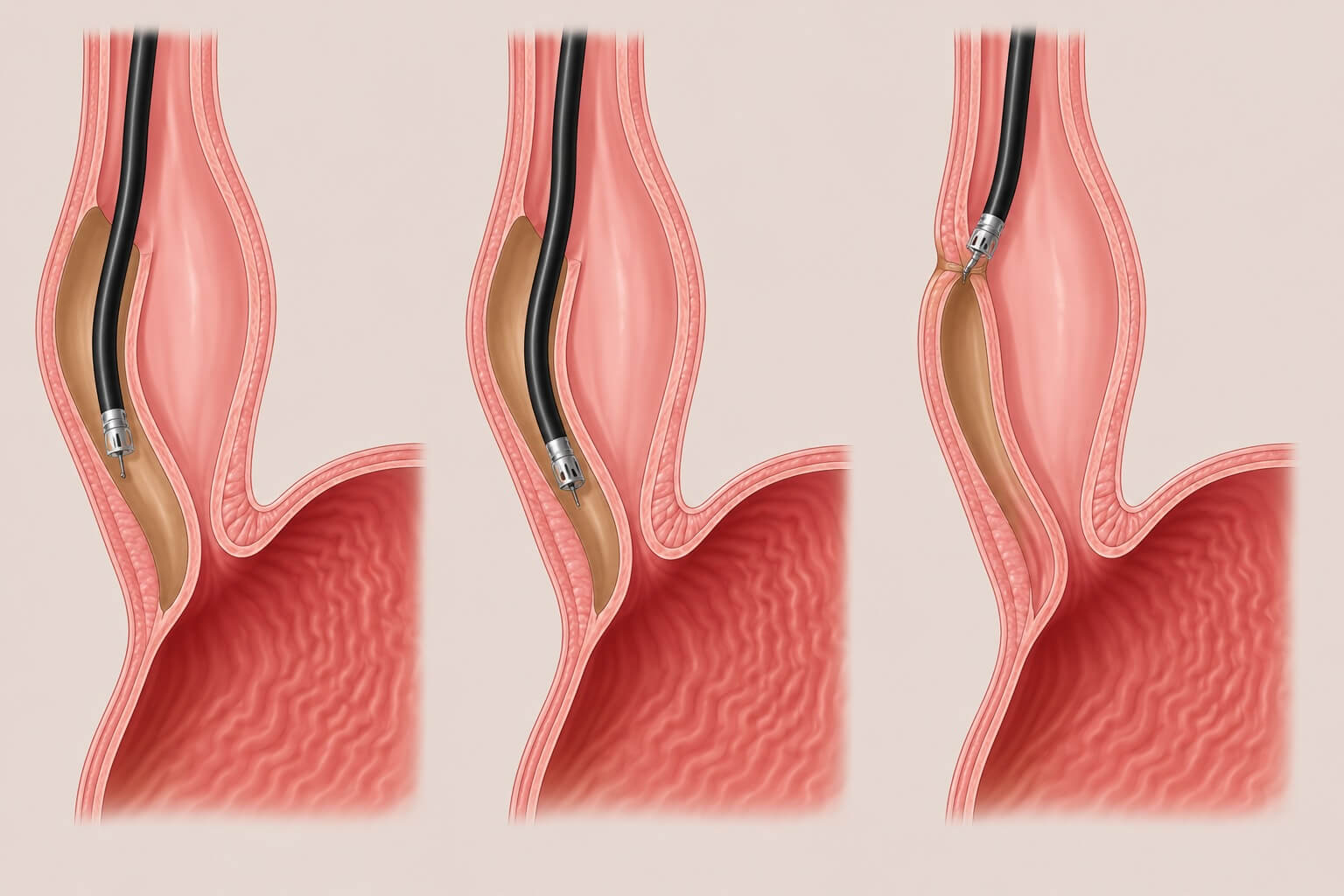
POEM, and its gastric variant G-POEM, is an advanced interventional endoscopy technique. It is performed under general anesthesia, through the natural orifices, without any incisions through the skin.
The physician inserts a flexible endoscope through the mouth into the esophagus. A small incision is made in the esophageal mucosa, through which the physician inserts the endoscope into the submucosal space, creating a tunnel. Through this tunnel, the endoscopist accesses the muscle fibers responsible for the spasm and precisely cuts them. The mucosal incision is then closed with clips. The procedure lasts on average between 20 minutes and one hour[RG1] depending on the case.
For G-POEM, the principle is the same, but it is performed at the pylorus (the muscle at the exit of the stomach) to treat certain forms of gastroparesis that are refractory to medical treatments.
Thanks to this procedure, there are no external scars, and recovery is significantly faster than with conventional surgery. Patients generally resume a blended diet the day after the procedure, then a normal diet within a few days to a week.
Promising Results, Necessary Follow-Up
The available data on POEM are encouraging. Two-year clinical success rates exceed 90% in several randomized studies*, with a marked improvement in symptoms and quality of life. The procedure also has a strong safety profile: serious complications are rare, occurring in less than 1% of cases in the series published to date.
POEM may, however, increase the risk of gastroesophageal reflux in some patients, due to relaxation of the esophageal sphincter. This reflux is generally controlled with antacid medication, and regular endoscopic monitoring is recommended, particularly in younger patients.
« These techniques often provide remarkable functional benefits. Many patients present with severe dysphagia prior to the procedure, or even aphagia in advanced cases. Rapidly restoring the ability to eat normally is the central goal of this treatment.»
— Dr Pierre Guibert, gastroenterologist, CIEL – Hôpital de La Tour
Essential Multidisciplinary Care
POEM is not a standalone procedure. It is part of a structured care pathway based on close collaboration among several specialties at Hôpital de La Tour.
Diagnosis is primarily based on high-resolution esophageal manometry, the gold-standard test for characterizing motor disorders. For achalasia, Dr. Diana Ollo provides this expertise in functional gastrointestinal testing. For gastroparesis, gastric emptying scintigraphy—performed in the nuclear medicine department by Dr. Claire Tabouret-Viaud—allows for the objective assessment and quantification of delayed gastric emptying and helps determine the need for surgery.
The procedure itself involves the operating room anesthesia team and CIEL’s expert gastrointestinal endoscopy nursing team, whose technical expertise and coordination are critical to the safety and quality of the procedure.
This multidisciplinary model is essential for providing each patient with safe, precise care tailored to their specific situation.
* Data from the multicenter randomized trial by Ponds et al. (JAMA, 2019), which reports a 92% clinical success rate at two years for POEM, and from the international multicenter retrospective analysis by Haito-Chavez et al. (American Journal of Gastroenterology, 2017), involving 1,826 patients across 12 international centers.