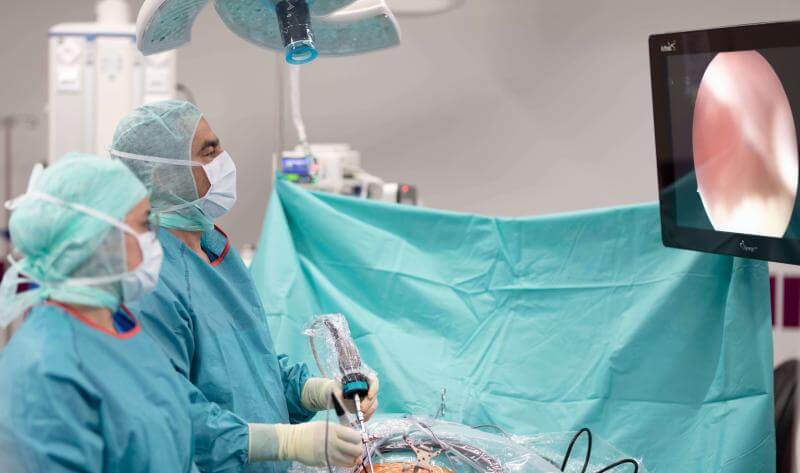
A minimally invasive technique that preserves muscle tissue
Single-port endoscopy, developed in the 1980s, became widespread in the 1990s. However, its complexity and steep learning curve have slowed its adoption. More recently, biportal endoscopy relies on two small incisions: one for a camera providing precise visualization, and the other for inserting surgical instruments. This technique, which is more similar to arthroscopy, offers the surgeon greater freedom of movement and allows for more precise procedures, particularly for the treatment of lumbar spinal stenosis.
“Unlike conventional surgery, which involves making an incision and detaching muscles, biportal endoscopy allows for a more targeted treatment of conditions while preserving the muscular and joint structures essential to the stability of the spine,” explains Dr. Faundez.
A Major Benefit for Patients
Three years after the first procedure in French-speaking Switzerland, biportal endoscopy has established itself as a preferred alternative for various spinal conditions:
- Lumbar and cervical disc herniations
- Narrow lumbar spinal canal
- Cases of degenerative scoliosis
For older adults, particularly those with degenerative scoliosis, this approach allows for the widening of the lumbar spinal canal without the need for metal rods, thereby reducing the risk of complications. Unlike open surgery, endoscopy minimizes damage to muscles and joints. This technique enables a faster recovery and significantly reduces postoperative pain.
"We have expanded its use to cervical herniated discs and the treatment of a narrow lumbar spinal canal, with excellent results. In elderly patients, it often eliminates the need for implants to stabilize the spine, thereby reducing complications. For elite athletes, it allows them to return to competition very quickly—sometimes as early as one month after surgery. This represents a significant improvement over the six weeks to three months previously required.”
A Technological Advancement in the Service of Precision
That’s not all—biportal endoscopy also reduces the risk of complications such as dural tears, whose incidence drops from 4–5% in conventional surgery to less than 2%. This technique requires surgeons to adapt, particularly to master indirect visualization and the use of specialized instruments.
The future of endoscopy will involve innovations such as surgical navigation and augmented reality, which allow for greater precision and reduce surgical risks, particularly in the cervical spine.
“Today, technical improvements are underway with navigation systems to help us better orient ourselves and ensure even safer surgical procedures. Augmented reality will allow us to visualize the structure of the spine in real time, and is a very promising development.”
Furthermore, new techniques allow implants to be inserted in a much less invasive manner, paving the way for more targeted treatments for scoliosis and other deformities.
Hôpital de La Tour is recognized as a leading center for biportal endoscopy.
Dr. Faundez does not merely perform this technique; he also trains other surgeons, both in Switzerland and internationally. This collaboration is essential for furthering the development of endoscopy and opening new horizons for the surgery of tomorrow.
Watch the full interview with Dr. Faundez: