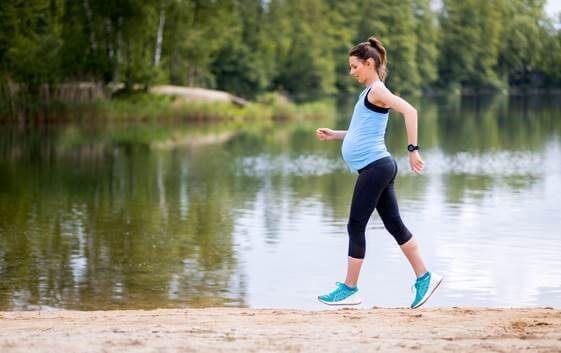
Indeed, the health benefits of physical activity and its positive impact on cardiometabolic risk are well established. However, data from the Federal Statistical Office show that about one-quarter of women of childbearing age are not physically active enough. Furthermore, out of fear of complications, many women reduce their level of physical activity during pregnancy. And yet, when practiced with certain precautions in mind, physical activity is safe during pregnancy and significantly reduces the risk of complications.
Prenatal Exercise Reduces Obstetric Risk
Building on U.S. guidelines issued for the general population, the benefits of moderate-intensity endurance exercise for at least 150 minutes per week have been studied during pregnancy.
Published data show that physical activity is safe during pregnancy. Prenatal exercise is not associated with an increased risk of miscarriage (10 RCTs, n=2,248), preterm birth (27 RCTs, n=5,283), or low birth weight (10 RCTs, n=1,262).
Furthermore, recent meta-analyses show that prenatal exercise is beneficial and significantly reduces the risk of gestational hypertension (39%, 22 RCTs, n=5,316) and preeclampsia (41%, 16 studies, n=3,401).
Metabolically, there is also a reduction in gestational diabetes (38%, 26 RCTs, n=6,934), excessive weight gain during pregnancy is limited (32%, 15 RCTs, n=3,519), and the risk of macrosomia is reduced (39%, 15 studies, n=3,670).
Furthermore, physical exercise during pregnancy also improves psychological well-being by significantly reducing depressive symptoms and anxiety, and helps reduce the intensity of lower back and pelvic pain.
Precautions and Contraindications
To minimize the risk of injury, exercise must take into account the anatomical and physiological changes associated with pregnancy. For example, the shift in the center of gravity can increase the risk of falls, and hormonal softening of joint tissues increases the risk of sprains.
In general, sports activities with a high risk of falls or abdominal impact are not recommended. Caution is also advised for activities at high altitudes (>2,500 m) as well as scuba diving.
In the event of obstetric complications, the intensity of physical exercise must be evaluated by a physician. Absolute and relative contraindications, as published by expert societies, can guide this decision (JOGC 2019).
A Tailored, Individualized Program
Pregnancy is an ideal time to discuss physical exercise with our patients, whether to advise them on their current sports activities or to encourage them to take up a new one.
Physical therapists, in collaboration with the Health & Performance team at Hôpital de La Tour, offer professional guidance on physical activity during pregnancy. This spring, Hôpital de La Tour is launching an innovative program tailored to all fitness levels of pregnant women:
- Active and athletic pregnant women: advice and guidance on adapting exercise routines to the anatomical and physiological changes of pregnancy
- Healthy pregnant women: introduction and support to gradually reach recommended activity levels
- Pregnant women with health issues: physical activity supervised by a professional and prescribed by a doctor.
Various sports activities will be offered throughout the program, including: aqua aerobics, Pilates, stretching, and brisk walking, available as either a long-term program (once a week—1 hour per session) or monthly workshops (1 hour and 30 minutes each month).
Dr. Agnès Ditisheim, MSc and Ms. Aurélie Delacroix-Tarenne
More info: Sports & Pregnancy Programs
References
1. Davenport MH, Ruchat S-M, Poitras VJ, et al. Prenatal exercise for the prevention of
gestational diabetes mellitus and hypertensive disorders of pregnancy: a systematic
review and meta-analysis. Br J Sports Med 2018;52:1367–75.
2. Kusuyama J, Alves-Wagner AB, Makarewicz NS, Goodyear LJ. Effects of maternal and paternal exercise on offspring metabolism. Nat Metab. 2020 Sep;2(9):858-872. doi: 10.1038/s42255-020-00274-7. Epub 2020 Sep 14. PMID: 32929233; PMCID: PMC7643050.
3. Davenport MH, McCurdy AP, Mottola MF, et al. Impact of prenatal exercise on both
prenatal and postnatal anxiety and depressive symptoms: a systematic review and
meta-analysis. Br J Sports Med 2018;52:1376–85.
4. Bø K, Artal R, Barakat R, et al., Exercise and pregnancy in recreational and elite athletes: 2016 evidence summary from the IOC expert group meeting, Lausanne. Part 1—Exercise in women planning pregnancy and those who are pregnant. Br J Sports Med. May 2016;50(10):571–89. doi: 10.1136/bjsports-2016-096218. PMID: 27127296.
5. Davenport MH, Kathol AJ, Mottola MF, et al. Prenatal exercise is not associated with
fetal mortality: a systematic review and meta-analysis. Br J Sports Med 2018. [Epub ahead of print].