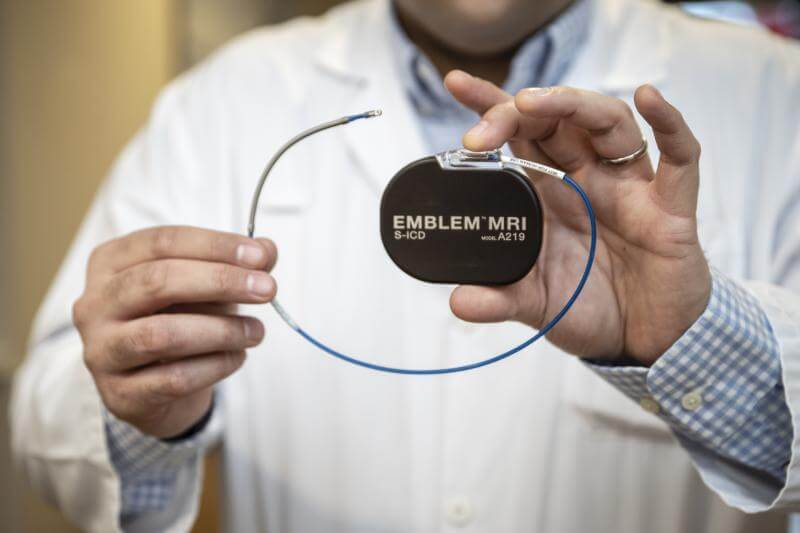
La Tour Hospital is now implanting subcutaneous defibrillators. What is it? What are its benefits? Learn more about this innovative device.
What is it?
An implantable defibrillator is a device, no larger than a few centimeters, intended for people at risk of sudden death. Its purpose is to monitor the heart’s rhythm and, in the event of a serious arrhythmia, deliver an electrical shock to restore a normal rhythm. This device can be implanted following a cardiac arrest caused by an arrhythmia or as a preventive measure in patients at high risk for arrhythmias.
There are currently two types of devices: the newer subcutaneous ICD (or S-ICD), used at Hôpital de La Tour, and the conventional transvenous automatic ICD.
How is it implanted?
The procedure to implant a subcutaneous defibrillator is performed under deep sedation and takes less than an hour. The defibrillator is implanted on the left side of the chest, between the muscle layers beneath the skin. A lead connected to the defibrillator is also implanted under the skin, to the left or right of the sternum. The major advantage of this system over the transvenous ICD is that it is entirely subcutaneous. The hospital stay lasts one day, so the patient is discharged the day after the procedure.
What is daily life like with a subcutaneous ICD?
People with a subcutaneous defibrillator can play sports, work, and pursue their hobbies as usual. Common electronic devices (such as cell phones) have no effect on the defibrillator. Its battery has a lifespan of about five to seven years. At the end of this period, it must be replaced, which requires a minor procedure.
What are the benefits?
Unlike a traditional transvenous defibrillator, the subcutaneous defibrillator does not come into contact with the heart or veins, so there is no risk of infection. The device can also be removed if necessary, without any risk to life, thanks to its location outside the heart.
The subcutaneous defibrillator is a state-of-the-art device that offers a real advantage to young patients and those at risk of infection.
If you would like to learn more, the cardiology department at Hôpital de La Tour is here to help.